
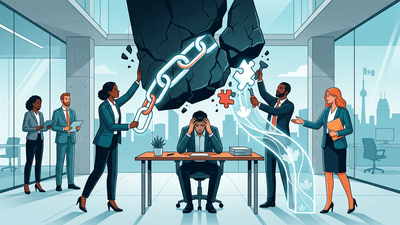



In the fast-paced evolution of the modern Canadian workplace, an insidious threat has woven itself into the fabric of our daily operations. It doesn't arrive with the sudden shock of a market crash or the immediate disruption of a supply chain failure. Instead, it creeps in through late-night emails, perpetual understaffing, and the blurring lines between professional and personal life. According to a stark new report, nearly half of Canadian workers say they feel burned out, elevating chronic exhaustion from a personal grievance to a systemic economic threat. For HR professionals across the country, the mandate is clear: we can no longer afford to treat burnout as a peripheral wellness issue. It is Canada's silent workplace crisis, and employers must lead the recovery.
For years, the corporate response to employee stress has been well-intentioned but fundamentally flawed. We have relied on resilience training, mindfulness apps, and casual Fridays to combat what is essentially a structural problem. As we navigate the complexities of 2026—balancing hybrid work models, economic pressures, and an increasingly vocal workforce—HR must pivot from offering superficial band-aids to orchestrating deep, organizational change.
The Economic and Cultural Toll of Exhaustion
To understand the urgency of this crisis, we must look beyond the emotional toll and examine the operational impact. Burnout is a direct drain on Canadian productivity. When nearly 50% of the workforce is operating in a state of depletion, the ripple effects are felt in every department. Cognitive fatigue leads to higher error rates, diminished creativity, and a sharp decline in customer service quality.
"Burnout is no longer an individual failing; it is an organizational vulnerability that directly compromises our national productivity and the long-term sustainability of our workforce."
Furthermore, the retention costs associated with burnout are staggering. In a competitive talent market, top performers are no longer willing to sacrifice their mental health for a paycheck. They will quietly disengage, coasting on bare-minimum effort—a phenomenon we've come to know as 'quiet quitting'—before eventually leaving for organizations that prioritize true work-life integration. For HR, the cost of replacing these seasoned professionals far outweighs the investment required to build a sustainable work environment.
The Evolution of Wellness: From Perks to Job Design
The core of the issue lies in how organizations define employee well-being. Historically, wellness programs have focused on the individual, implicitly suggesting that it is the employee's responsibility to manage the stress inflicted upon them by their job. However, leading HR thinkers are now recognizing that job design is the most potent lever for mitigating burnout.
If an employee is managing the workload of three people with ambiguous deadlines and zero autonomy, a corporate subscription to a meditation app is not just ineffective; it can be perceived as insulting. The transition from traditional wellness to structural well-being requires a fundamental shift in HR strategy.
| Focus Area | Traditional Wellness (The Band-Aid) | Structural Well-being (The Cure) |
|---|---|---|
| Workload | Offering time-management seminars to overwhelmed staff. | Auditing capacity, hiring adequately, and ruthlessly prioritizing projects. |
| Flexibility | Allowing occasional work-from-home days as a "perk." | Implementing core collaboration hours and asynchronous workflows. |
| Recovery | Sponsoring after-hours team-building events. | Enforcing strict "right to disconnect" policies and mandatory PTO usage. |
| Recognition | Annual "Employee of the Month" awards. | Continuous, specific feedback and equitable compensation structures. |
Actionable Strategies for HR Professionals
Recognizing the structural nature of burnout is only the first step. HR leaders must implement concrete strategies to dismantle the conditions that cause it. Here are three critical areas where Canadian HR professionals can drive immediate change.
1. Auditing Workloads and Capacity
The most common driver of burnout is chronic overwork. Following years of economic uncertainty and subsequent "lean" operating models, many employees are carrying unsustainable loads. HR must partner with department heads to conduct realistic capacity audits. This involves:
- Mapping actual hours worked versus contracted hours, paying special attention to salaried employees who may be absorbing hidden overtime.
- Identifying redundancy and low-value tasks that can be automated or eliminated to free up cognitive bandwidth.
- Establishing clear boundaries around scope creep, ensuring that when new responsibilities are added to a role, old ones are removed or reprioritized.
2. Redefining Managerial Competencies
Managers are the frontline defense against burnout, yet many are promoted based on technical proficiency rather than leadership capability. A manager who micromanages, fails to provide clear direction, or models toxic overwork will rapidly burn out their team. HR must redefine what makes a successful manager in 2026.
Training programs must shift focus toward empathetic leadership, active listening, and psychological safety. Managers need the tools to recognize the early behavioral signs of burnout—such as increased cynicism, withdrawal from team interactions, or uncharacteristic drops in performance—and the authority to intervene by adjusting deadlines or redistributing work.
3. Enforcing True Disconnect Policies
While provinces like Ontario have pioneered "Right to Disconnect" legislation, simply having a policy on paper is insufficient. The culture of an organization often overrides its written rules. If the CEO sends emails at 11:00 PM on a Saturday, employees will feel pressured to respond, regardless of what the employee handbook dictates.
HR must champion a culture where disconnecting is not just allowed, but expected. This can be achieved by:
- Implementing email server delays that prevent non-urgent internal communications from being delivered outside of core business hours.
- Training leadership to visibly model healthy boundaries, such as publicly taking vacation time and remaining completely offline while away.
- Evaluating employees on their output and impact, rather than their perceived availability or response time.
Data-Driven Empathy: Catching Burnout Early
To effectively lead the recovery, HR must move from reactive crisis management to proactive prevention. This requires leveraging HR analytics to catch the early warning signs of burnout before they result in a medical leave or a resignation.
Traditional annual engagement surveys are too infrequent to capture the dynamic nature of employee stress. Instead, HR should utilize continuous listening strategies, such as monthly pulse surveys focusing specifically on workload manageability and psychological safety. Furthermore, tracking metrics like an uptick in short-term absenteeism, a decrease in PTO utilization (indicating employees feel too busy to take a break), and high turnover in specific departments can pinpoint exactly where structural interventions are needed most.
The revelation that nearly half of our workforce is operating on the brink of exhaustion should serve as a wake-up call for corporate Canada. As HR professionals, we are the architects of workplace culture. We have the unique opportunity—and the responsibility—to redesign the Canadian workplace into an environment where high performance and human well-being are not mutually exclusive. By moving past the band-aid solutions of the past and addressing the root causes of workplace stress, we can dismantle this silent crisis and build a more resilient, sustainable future for Canadian business.